Gaming in 2026 is no longer a simple “PC vs console” discussion. For IT professionals, the more relevant question is where the compute happens, where the content lives, and how reliably the experience can be delivered across wildly different networks and devices. The average user now sees gaming as an ecosystem: a library, a social graph, a save state, and a performance expectation that follows them from living-room TV to handheld to laptop to phone.
Cloud gaming didn’t “replace” local gaming, and local gaming didn’t “win” the war. What emerged is an expectation of choice. Users want the flexibility to stream when it’s convenient, install locally when quality matters, and combine both when the situation calls for it. For IT, that translates to a multi-modal workload: interactive video at scale, low-latency input paths, content delivery and caching, identity and entitlement systems, device management, and a constant negotiation between bandwidth, latency, power draw, and cost.

What “Preference” Really Means in 2026
When someone says they “prefer” cloud or local gaming, they rarely mean ideology. They mean the sum of their lived constraints. Preference in 2026 is shaped by internet quality, household congestion, data caps, subscription fatigue, the availability of a high-end GPU, noise and heat tolerance, and how much friction it takes to start playing. Users prefer what works reliably and predictably in their specific context.
This is why you’ll see the same person stream a session on a hotel Wi-Fi one day and install a 120GB title locally the next. The user’s preference is not a permanent identity; it’s a decision engine. The winning platforms are the ones that understand those decision triggers and reduce the penalties of switching modes.
Cloud Gaming in 2026: Where It Works—and Why People Choose It
Cloud gaming in 2026 is at its best when users want instant access and hardware independence. For many, the attraction is simple: no downloads, no patches, no storage management, and no expensive upgrades. A game becomes an “app-like” experience: click and play, even on modest devices.
From an IT perspective, the cloud model looks like a specialized form of remote desktop that must behave like a console. It’s not just video streaming; it’s an end-to-end system that includes controller input timing, encoder latency, adaptive bitrate, region routing, and session persistence. The moment any link in that chain stutters, users feel it as input lag, blur, or “why does this feel off?”
Users who gravitate to cloud gaming usually fall into a few patterns. Some are casual or time-limited players who value immediacy over absolute fidelity. Some are travelers or commuters who want access anywhere. Some are households that don’t want multiple high-end rigs. And some are simply tired of managing the operational overhead of modern titles: the patch cycles, driver quirks, shader compilation waits, and storage churn.
The cloud also appeals because it can flatten the “minimum spec” anxiety. When games push rendering techniques that would otherwise demand new GPUs, a streaming tier can offer access—assuming the network holds. In 2026, that trade remains the defining tension: cloud gaming is brilliant when connectivity is stable and sufficiently low-latency, and frustrating when it’s not.
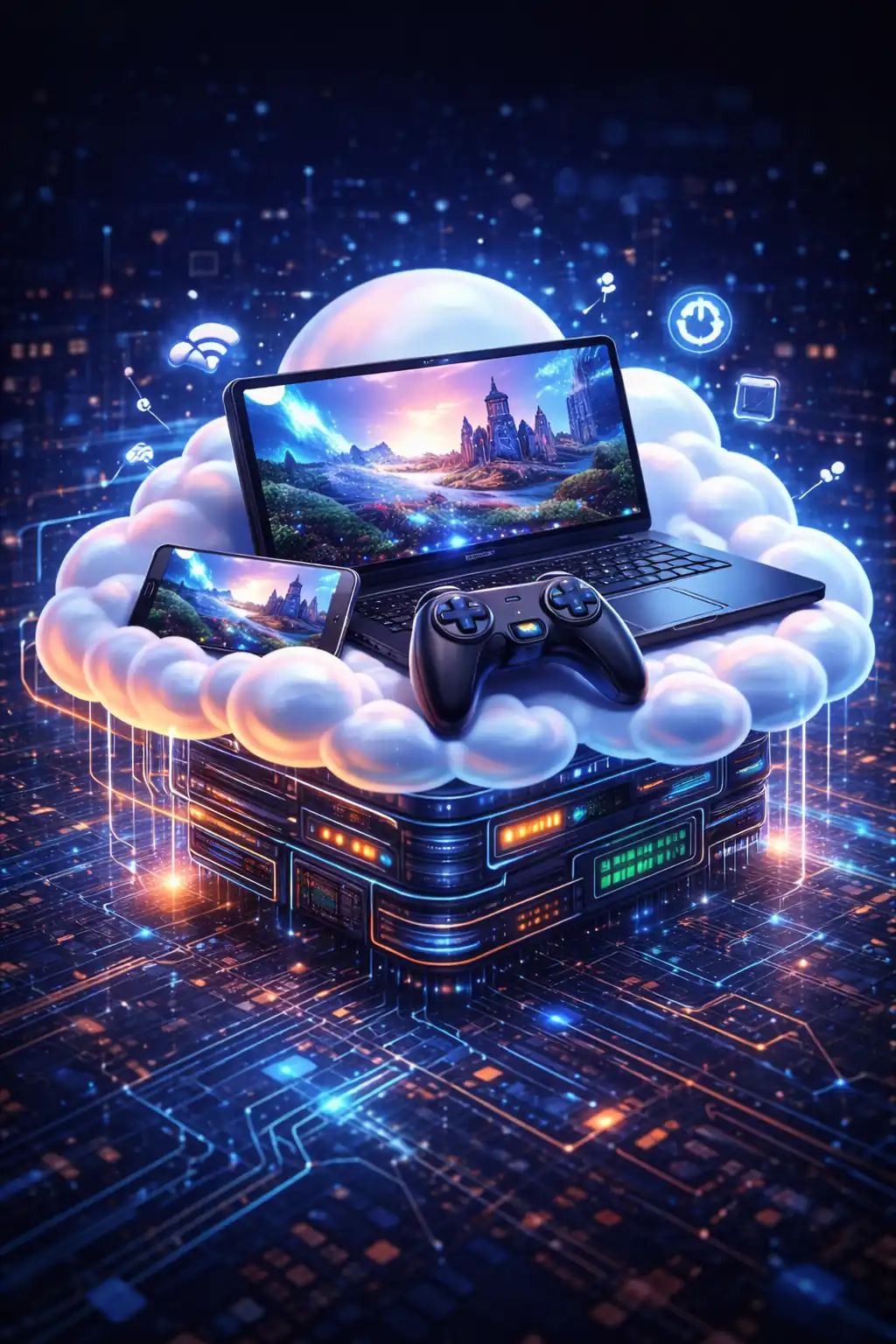
Consumer cloud gaming services
-
NVIDIA GeForce NOW (stream PC games you own from stores like Steam/Epic, etc.). NVIDIA+2NVIDIA+2
-
Xbox Cloud Gaming (Microsoft) (cloud play as part of the Xbox ecosystem / Game Pass). Xbox.com+1
-
PlayStation cloud streaming (Sony / PlayStation Plus Premium) (stream select titles on PS5 / Portal, etc.). PlayStation+2PlayStation+2
-
Amazon Luna (Amazon) (cloud gaming service with a rotating library and channel-style access). luna.amazon.com+1
-
Boosteroid (multi-device cloud gaming service, popular in Europe). boosteroid.com
-
Blacknut (subscription cloud gaming catalog across PC/mobile/Smart TV). Blacknut Cloud Gaming+1
-
Antstream Arcade (cloud-streamed retro catalog). Antstream+1
Local Gaming in 2026: Still the Gold Standard for Quality and Control
Local gaming remains the benchmark for responsiveness, visual stability, and configurability. Even as streaming improves, the physics of distance and congestion still matter. Competitive players, VR users, and anyone sensitive to latency continue to favor local compute. The same is true for users with inconsistent internet or those who want their experience to be independent of service availability.
Users also prefer local when they care about high refresh rates, high-resolution texture packs, modding, or niche peripherals. PC gaming in particular remains a “toolbox” culture. People expect granular control of settings, overlays, fan curves, reshade profiles, and capture pipelines. They want mods that transform games into platforms, and they want community content that can’t easily be validated or delivered through cloud-only stacks.
Local gaming also maps to a sense of ownership, even in a world dominated by digital entitlements. The psychological comfort of “it’s installed and it works offline” is a real preference driver. For IT, this comes with the familiar burdens: patch management, anti-cheat compatibility, driver regression risks, storage performance bottlenecks, and troubleshooting that ranges from corrupted installs to overlay conflicts.
In 2026, local gaming is less about rejecting cloud and more about choosing certainty. Users want predictable frame pacing, predictable latency, predictable image quality, and predictable availability. When the user cares deeply about the outcome, local remains the safer bet.
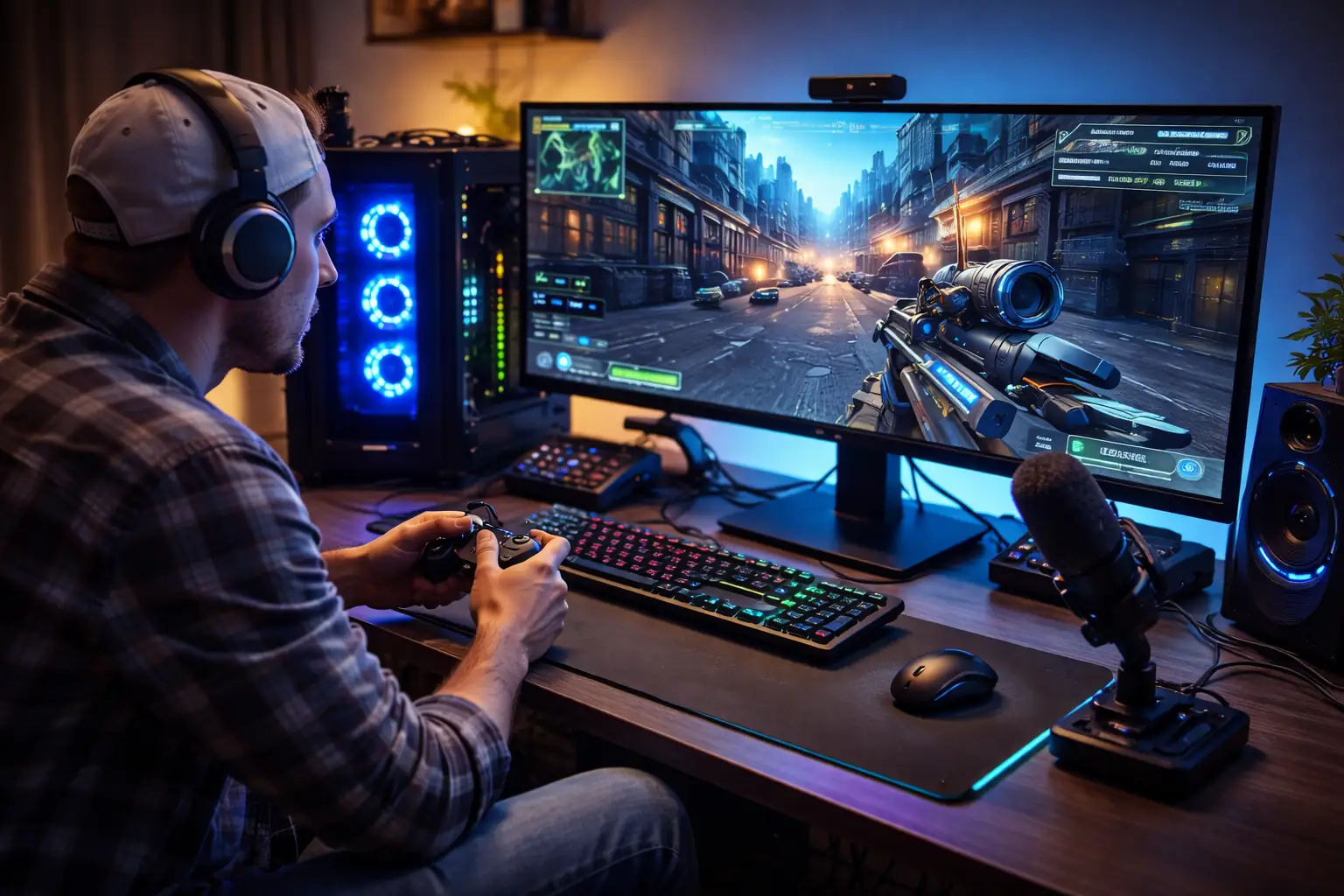
Here are solid vendors/options for local gaming:
PC gaming platforms (store + launcher)
-
Steam (Valve)
-
Epic Games Store
-
GOG (DRM-free)
-
EA app
-
Ubisoft Connect
-
Battle.net (Blizzard)
-
Microsoft Store / Xbox app (PC)
-
itch.io (indie)
Hybrid Gaming: The Quiet Default for Most People
Hybrid gaming is not a niche compromise; it has become the practical default. Hybrid means users move fluidly between streaming and local install depending on the game, the device, the network, and the moment. It can also mean partial streaming: streaming a game while a local install finishes, streaming a higher-quality version remotely while using a lower-power device, or using cloud compute for occasional play while keeping core favorites installed.
Users prefer hybrid because it reduces regret. If the cloud session is unstable, they can install. If storage is tight, they can stream. If they’re away from their main machine, they can resume from the cloud. Hybrid models give users options without forcing them to commit to a single infrastructure philosophy.
For IT professionals, hybrid is also the hardest to deliver well. It requires coherent identity, entitlement, saves, cross-progression, and device continuity. It demands consistent input behavior across devices, predictable matchmaking, and a library experience that doesn’t confuse users with multiple “versions” of the same title. It also raises the bar for observability: when a user reports “it feels laggy,” the root cause could be local thermals, Wi-Fi jitter, encoder settings, regional routing, or a background upload saturating upstream bandwidth.
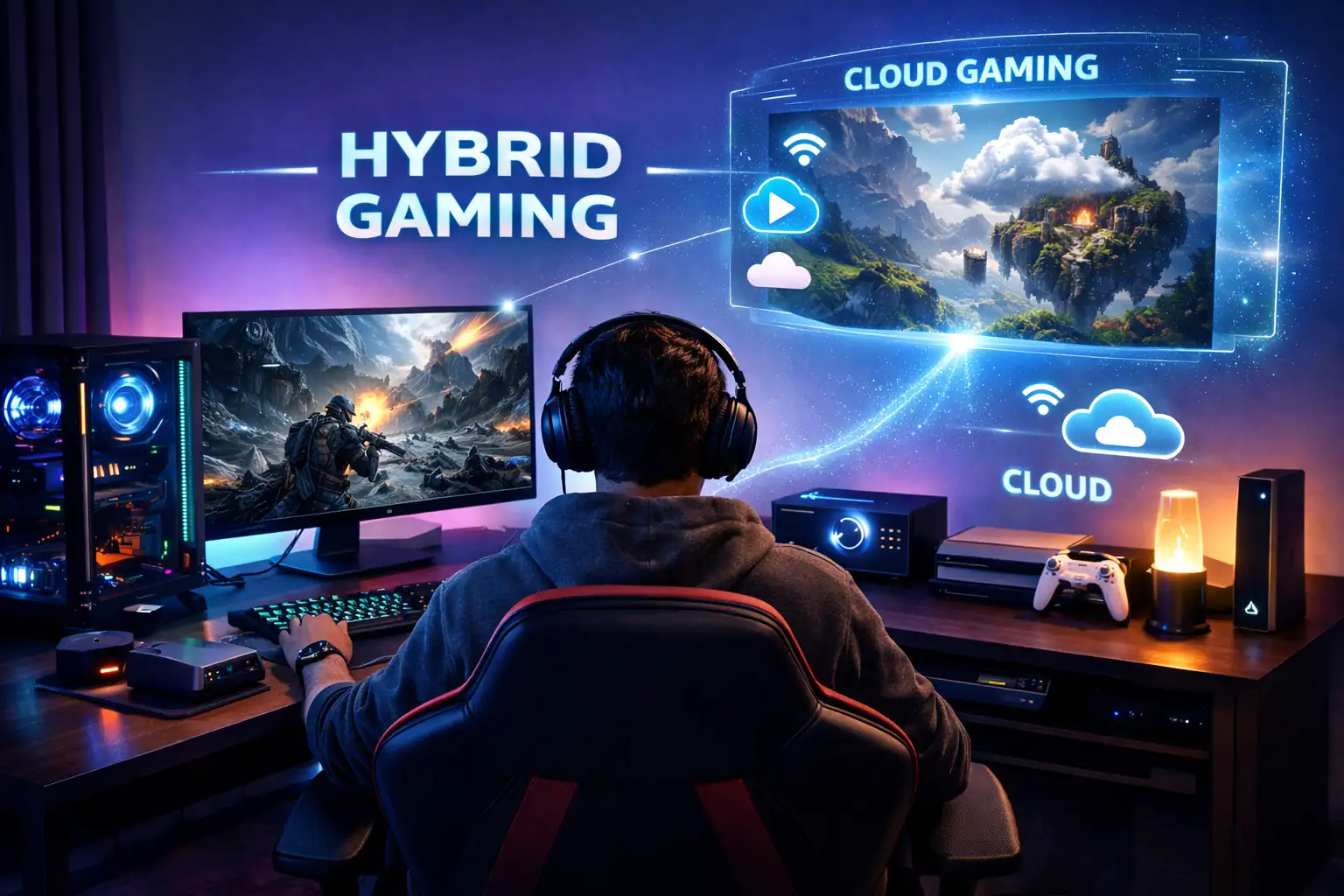
Hybrid gaming vendors in 2026: shortlist + what each is best for
NVIDIA GeForce NOW
-
Best for: “Play anywhere” without buying a gaming PC—stream demanding titles to a modest laptop, mini-PC, or handheld.
-
Why it’s hybrid: You can stream games you own on supported PC stores, while still keeping a local gaming setup at home for offline/low-latency sessions.
-
Great fit when: Your users bounce between home (local) and travel (cloud).
Amazon Luna
-
Best for: Simple, “turn it on and play” cloud sessions across devices, often with channel-style libraries.
-
Why it’s hybrid: Users often keep a console/PC for local play, but use Luna for instant access on secondary screens (living room stick, laptop, tablet).
-
Great fit when: Convenience matters more than maximum graphics settings.
Shadow PC (Cloud Gaming PC)
-
Best for: A full remote Windows gaming PC in the cloud—install mods, launchers, and non-streaming-friendly games (depending on your setup).
-
Why it’s hybrid: It’s essentially a second PC you can access anywhere; many gamers keep a local PC/console and use Shadow when away or when they need extra horsepower.
-
Great fit when: You want PC freedom (mods, launchers, settings) but not the upfront hardware cost.
Parsec
-
Best for: Low-latency streaming from your own PC (or a hosted machine) with a “feels local” remote-play experience.
-
Why it’s hybrid: The game still runs on your local rig (or your rented rig), but you can play it remotely from a lightweight device—best of both worlds.
-
Great fit when: You already own a gaming PC and want to extend it to a laptop, office PC, or another room.
The Real User Tradeoffs: Latency, Bandwidth, and Image Quality
The biggest differentiator between cloud and local gaming remains latency. Users don’t always describe it accurately, but they feel it. Input lag shows up as “sluggish,” “floaty,” or “it’s like I’m steering a boat.” Even when latency is technically acceptable, variability is what breaks immersion. Jitter and buffer swings can feel worse than a consistent, slightly higher delay.
Bandwidth is the second factor, but it’s not only about raw speed. Consistency matters more than peak throughput. A household can have a fast connection and still deliver poor game streaming if Wi-Fi is congested, upstream is saturated, or bufferbloat is uncontrolled. Users may not say “bufferbloat,” but they will say “it’s fine until someone starts a video call.”
Then there’s image quality. In 2026, users are increasingly sensitive to compression artifacts, especially on large TVs and high-resolution monitors. Fast motion, dark scenes, foliage, particle effects, and HUD text can expose video encoding limits. Many users tolerate some softness when streaming on a smaller device, but they expect local-level clarity on a big screen. This is one reason hybrid wins: users stream for convenience and install for “movie night” quality.
Cost, Subscriptions, and the “Value” Conversation
User preference is also shaped by economics. Cloud gaming often lands in a subscription bundle, which can feel like value—until the household accumulates too many subscriptions. By 2026, subscription fatigue is a measurable force. Users frequently ask themselves whether they should pay monthly for access or invest once in hardware that lasts for years.
Local gaming has a different cost curve: higher upfront spend, but potentially lower recurring cost. Yet local gaming also carries hidden expenses: storage upgrades, cooling solutions, power consumption, and the time cost of maintenance. Users who love tinkering may not mind. Users who just want to play often see it as friction.
Hybrid approaches can reduce the pain on both sides. Users might maintain a mid-range local machine and rely on cloud for the occasional “heavy” title. Or they might use cloud to try games and only install what becomes a long-term favorite. In both cases, preference is shaped by how visible and controllable the cost feels.
Device Diversity: Handheld PCs, TVs, Phones, and the New Entry Points
The 2026 gaming audience is distributed across more device classes than ever. TVs are better streaming endpoints. Phones are better controllers and displays than they used to be. Handheld PCs created a new “couch plus portability” category that can run locally but also benefits from streaming. Laptops continue to sit at the intersection of work and play, where users want performance without noise and heat.
Users often choose cloud gaming specifically because it makes more devices viable. A TV app and a controller can become a “console-like” setup with minimal hardware. For IT professionals, this means managing endpoint diversity: OS versions, controller compatibility layers, codec support, Wi-Fi chip quality, and the realities of consumer routers that were never optimized for latency-sensitive traffic.
Local gaming still thrives where users have a primary “anchor” device—typically a gaming PC or console. But even these users increasingly want continuity: start a session locally, continue on a smaller device, and maintain the same save and progression state. Hybrid isn’t just about compute; it’s about lifestyle.
Enterprise and Managed Environments: A Different Angle on Preference
While gaming is primarily consumer-driven, IT professionals often encounter it in managed or semi-managed contexts: campus networks, shared housing, hotels, co-working spaces, esports venues, and family environments where “home IT” resembles small business IT. In these environments, preference is often dictated by policy and network design rather than personal taste.
Cloud gaming can be a stress test for network QoS, peering, and Wi-Fi design. It’s a sustained, interactive stream that competes with conferencing and general streaming video, and it’s sensitive to upstream as well as downstream. Local gaming, by contrast, stresses patch distribution, content download peaks, and storage performance. Hybrid stresses everything, because the user might switch modes depending on conditions.
For IT pros supporting these environments, the goal is not to “pick a winner,” but to reduce user pain. That can mean better Wi-Fi coverage and channel planning, router settings that reduce bufferbloat, smarter traffic shaping, and reasonable policy decisions that don’t accidentally break controller pairing, NAT traversal, or UDP-heavy flows.
Security and Trust: What Users Assume, What IT Should Verify
Users rarely frame gaming choices as security choices, but the implications are real. Cloud gaming centralizes execution, which can reduce cheat surfaces on the client but also concentrates account value and identity risk. Local gaming keeps execution on the endpoint, which increases the importance of endpoint hygiene, driver integrity, and the safety of third-party tools and mods.
In 2026, users increasingly expect seamless sign-in across devices, which expands the blast radius of account compromise. Multi-factor authentication, session awareness, and device management become part of the gaming experience, whether users acknowledge it or not. Hybrid models raise the stakes further, because the same identity often unlocks cloud sessions, local installs, and cross-progression data.
IT professionals should view gaming platforms as large-scale identity providers plus content delivery networks plus real-time communications stacks. The user’s preference will follow whichever ecosystem feels safest while still being easy. Overly intrusive security can push users away; weak security can damage trust permanently.
Performance Troubleshooting in 2026: The New “It’s Laggy” Playbook
The phrase “it’s laggy” now spans multiple failure modes. For cloud gaming, you have to think in layers: last-mile Wi-Fi, router queueing behavior, ISP congestion, peering and regional routing, platform-side encoder and session load, and the decoding performance of the endpoint device. For local gaming, “laggy” can mean CPU scheduling, GPU saturation, VRAM pressure, thermal throttling, driver issues, background processes, or storage stalls.
Hybrid complicates everything because users may not realize they switched modes, or the platform might dynamically adjust quality and resolution behind the scenes. One of the most common user experiences in 2026 is “it was fine yesterday.” That often correlates with subtle changes: a new router firmware, a different Wi-Fi band selection, a new game patch, a driver update, or household usage patterns shifting.
For IT professionals, the practical approach is to isolate variables quickly. Test wired vs wireless. Check latency and jitter, not only speed. Identify upstream saturation. Verify NAT and firewall behavior. Confirm whether the session is cloud or local. Then look at endpoint performance counters and thermals. The tools differ, but the mindset is the same: reduce the system until the bottleneck reveals itself.
So What Do Users Prefer in 2026?
Most users prefer flexibility, even if they describe it as a preference for one mode. Cloud gaming is preferred when convenience, portability, and instant access matter more than absolute fidelity. Local gaming is preferred when performance, responsiveness, and control matter most. Hybrid is preferred because it reduces compromise and adapts to real life.
If there is a consistent “winner” in user preference, it’s not a platform type—it’s a promise. Users prefer the option that delivers a predictable experience with the least friction. They prefer the ecosystem that remembers their progress, respects their time, and works on the devices they already own. When those conditions are met, users are happy to mix cloud and local without thinking about it.
For IT professionals, the takeaway is that gaming in 2026 is a useful lens for modern computing trends. It exposes how far expectations have shifted: interactive workloads delivered over networks, identity-driven access, continuous patch pipelines, multi-device continuity, and real-time performance sensitivity. Supporting gaming-adjacent experiences—whether at home, in managed networks, or in product design—means designing for hybrid reality and minimizing the switching cost between modes.
The future of gaming is not a single destination. It’s a set of pathways. Users will keep choosing the path that fits the moment, and the most successful platforms will be the ones that make every path feel like the right one.

 10549
10549  IT Pro